My job is to teach people to play or sing music, whether it is as a conductor, music director or an educator. In the years of taking on new groups of people, probably the one downside of my job that frustrates me most is the degree to which I must start people from the very bottom rung to learn the music. To put this in perspective, whereas U.S. literacy rates are pretty high, around 95%, music literacy is very low — between 5% and 15%, depending upon what source you’re following.
Herewith, are some of my observations about reading music. Caveat: I’m not dissing choirs or choir conducting practice. Community and church choirs are essential to the community sharing of music and pleasurable interaction. However, choir is ground zero for non-readers. It is a viable and critically important place where people can go to make music with their friends, no experience necessary. But outside of professional or high-end amateur groups (aka opera, symphonic choirs, often musical theatre), proficiency with reading is generally seen as nonessential. So we choir directors have learned to work to the level of our groups and often get an excellent result. End of caveat.
So, take this for what it is — a simple alignment of reading skill vis a vis reading of our spoken language versus sung language.
If reading were taught as choir is taught:
Rote would be King! Each book would be dictated until memorized.
Therefore, books are unnecessary.
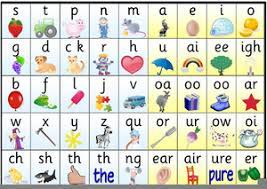
Therefore, the ABC’s would non-essential. Why bother with silly letters?
So, with no alphabet, there would be no forming of phonemes into words and from there into sentences.

The act of holding a book, learning how to follow the text across and down the page is how deep cognition and understanding develops. Learning by rote then means that the book becomes nothing more than a prop; there would be no need to develop a sense of flow, context, sense and depth because everything is dictated and every memorized book is parroted back exactly as the teacher taught it.
Teachers would gradually be pushed into meeting the students’ demands for content. So the only books taught would be audiobooks of popular fiction, graphic novels (graphics only) or rap lyrics. Cognitive skills of critical thinking and discernment would be extraneous and even discouraged.
Many boys and young men would refuse to learn because it would seem “sissy” or emasculating. They don’t need to read to do sports. (The analogy here is that choir directors often have to beg for men to join. Sopranos and alto vastly outnumber basses and particularly tenors.)

On the bright side, reading would include breath support and proper placement of the speaking voice. Some speakers would become very good orators and a few would develop a working practice of reading and learn to decode written language. But with no skills in critical thinking, many orators would be vulnerable to influence from others out to manipulate people towards their own interests.
Furthermore, not only would people still not know how to read, but would be completely restricted to the few bits of literature they had driven into their working memory.
Reading is the sole means by which we slip, involuntarily, often helplessly into another’s skin, another’s voice, another’s soul. When we are caught up in a good book we are held, spellbound, by another’s perspective.
– Joyce Carol Oates
If choir music were taught as reading is taught:
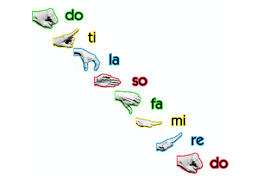
Every choir would start with solid foundations in understanding musical language and the decoding thereof: parts of printed music including staff lines, beat groupings against steady beat, time signatures, clefs and key signatures; note names and pitches associated with them, sounding out musical lines by intervals (which is essentially the same as sounding out words phonetically).
Students would have a comfortable familiarity with the sheet music, understanding how to hold it, how to find and track their part, and understand the complex symbolic language of notation. They would be learn to scan the music even before starting to read the notes.
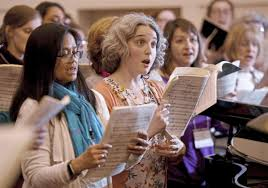
They would learn counting and rhythm as an extension of their own bodies, and learn how notes represent pitches and learn how to hear them.
They would come to see progressions of notes on the paper as related to each other by intervals. They would learn to “hear” the music before it is played. That would lead quickly to the ability to form musical sentences – phrases – into melodies, and their interpretation of the music would be natural and a sincere outpouring of their understanding of the composer’s will.
They would learn to be empowered in their understanding of this language. To be able to read for themselves and form depth and context and meaning from their reading.
We should read music in the same way that an educated adult will read a book: in silence, but imagining the sound.
-Zoltan Kodaly
They would learn that different styles – popular, classical, jazz, ethnic musics – are a part of the interweaving of many complex cultures. They would come to understand entire bodies of literature that give them cultural context and a sense of awe for the incredible artistry of all musical creators. They would grow to have a grasp of history and learn to seek out new music that is innovative and culturally inclusive as their curiosity is stimulated. The critical thinking involved in that process would deepen their understanding of music – and culture as an universal and ever-evolving process.
Boys and young men would learn along with girls and young women, because it would be a required subject and simply understood that learning to read music and use your God-given voice is a part of a well-rounded education and key to understanding ourselves and understanding other cultures. As with all learners, they would be proud of their accomplishments as those who excelled at singing and interpreting this beautiful, universal language would take their place on the world stage to share their knowledge and insight.
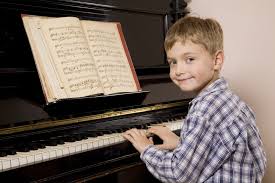
And yes, they would also learn to breathe properly and support their beautiful voices.
Basic literacy is critical in our lives and music is one of the few universal languages, both in expressive and literate forms. It is reprehensibly irresponsible of our schools to not provide this level of education for our youth, and an incredibly destructive blow to the cultural health in this country where music is almost entirely delivered (I’d say even force-fed) to us via Big Music Industry.
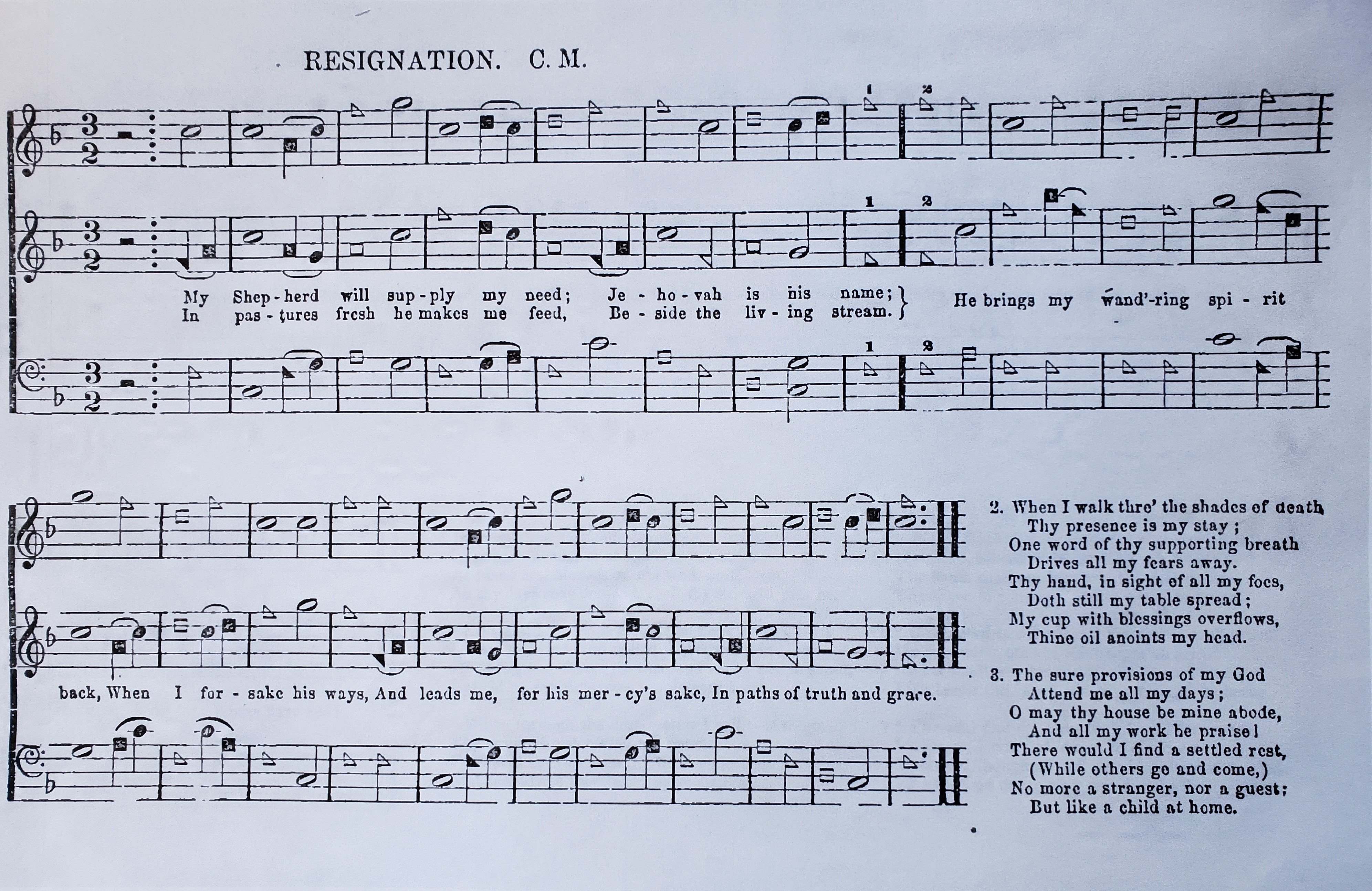
The image at the top is from Southern Harmony, and Musical Companion, a shape note hymn and tune book compiled by William Walker, first published in 1835. The tune is more familiarly sung as “My Shepherd Shall Supply My Need.” The different shaped notes are typical of the way singing masters adapted Solfege to differently shaped notes to aid in learning to read the song.
 Commonwealth Orchestra Outreach Project